Yantra: Sacred Geometry to Return to Centre
The yantra teaches that form can be prayer, too. In tarot, The Magician reminds us that focus, presence and intention can reorganise scattered energy.
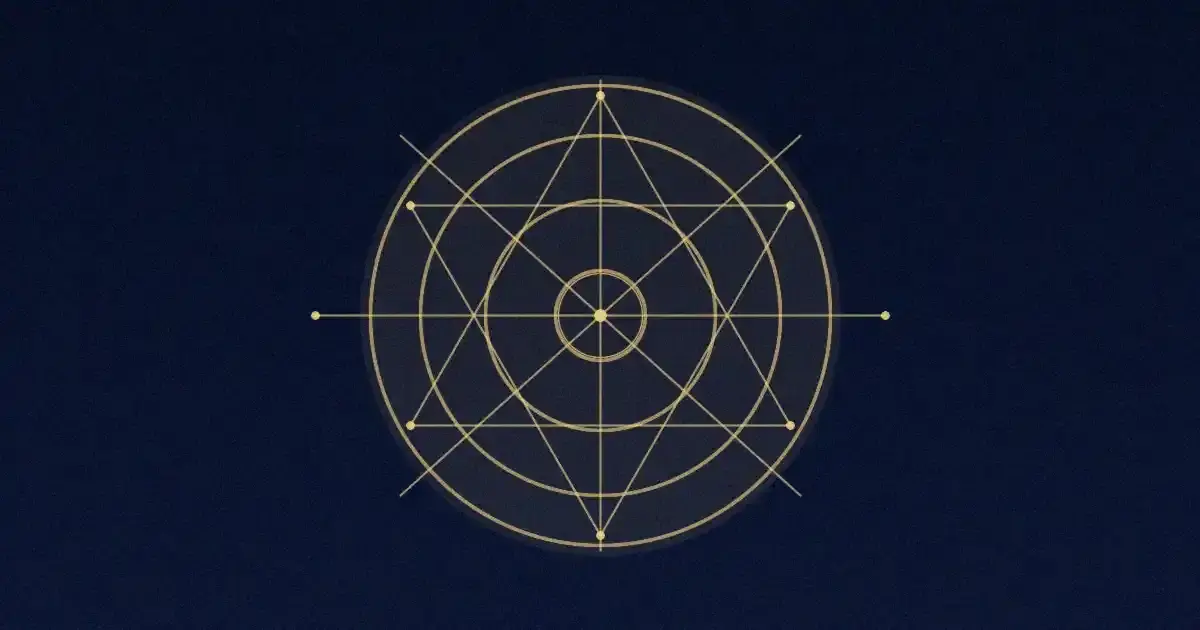
In Hindu tradition, the yantra is a sacred diagram made of a point, triangles, circles, lines and a lotus flower. It works as a support for meditation, concentration and returning to centre. In tarot, The Magician speaks to this wisdom because he shows how intention, focus and action can organise scattered energy.
Today's page
Today I found myself staring at my desk before I started writing. There was a cup, a candle, a notebook, a bill, a forgotten ring, three open tabs on the computer, and a small anxiety jumping from one thing to another. I wanted to answer everything, solve everything, understand everything. But the soul doesn't flourish when it turns into a window with twenty tabs open. That's when I remembered yantras — those sacred drawings from ancient India that seem to say, quietly: start from the centre. Before you rush outward, come back to the point.
What is a yantra
Yantra is a Sanskrit word that can be understood as instrument, support or vehicle. In Hindu and tantric spiritual practice, it appears as a geometric diagram used for meditation, contemplation and concentration. Some yantras are linked to deities, mantras and cosmic forces. The Sri Yantra, perhaps the best known, brings together interlocking triangles, circles and petals, forming a symbolic architecture of the universe and of consciousness. But I also like to look at the yantra in a more intimate way: as a map to help a tired mind remember that a centre exists.
The point that can't be explained
Almost every yantra has a central point, the bindu. It looks small, but it carries everything. The bindu is origin, seed, silence before form. This moves me deeply, because we tend to look for answers at the edges — in excess, in other people's opinions, in the message that never came, in the future that hasn't opened yet. The yantra points the other way. It says: look at the point. What is essential here. What is the true question behind the noisy one. What remains when the rush goes quiet.
The Magician as mirror
In tarot, The Magician is the card I place beside the yantra. He stands at the table with the four elements: earth, water, air and fire. Nothing is missing, but everything needs direction. The Magician doesn't create from nothing. He organises what's already available. That's a huge lesson for confusing days. Often you don't need another sign, another course, more advice, more confirmation. You need to gather what you already have and choose one gesture. The Magician's power isn't shouting at the universe. It's aligning hand, word, desire and action.
Geometry as care
There's a strange comfort in looking at repeated shapes. A circle doesn't argue with you. A triangle doesn't demand haste. A well-drawn line doesn't promise a miracle, but it offers a boundary. When your inner life is a mess, form can become care. Drawing a circle on paper, marking a point at its centre, breathing while looking at it — all of this seems too simple for a mind that wants a dramatic solution. But the simple, done with presence, carries an ancient force. The soul recognises rhythm.
When intention is scattered
Scattered intention is exhausting. You want love, but you respond from fear. You want money, but you shrink when it's time to charge for your work. You want peace, but you feed the same conversation in your head for hours. You want change, but you negotiate with the old habit every morning. The yantra doesn't accuse you of this. It simply shows the difference between dispersion and alignment. An aligned intention isn't a pretty sentence written once. It's a direction repeated in the body. It's the small choice that matches the big request.
It's not about controlling the universe
I need to write this with real tenderness: sacred geometry is not control over destiny. The yantra doesn't exist to force the universe to obey your anxiety. It exists to educate your presence. The line calls you back. The point reminds you of centre. The symmetry shows you that order is possible even when life feels crooked. Manifesting isn't about commanding the world. It's about stopping the fight with your own energy and starting to act with more coherence.
The beauty that disciplines
Some beauty distracts us. Other beauty disciplines us. The yantra has this second quality. It doesn't seduce with excess — it invites you to stay. Stay looking, stay breathing, stay noticing what shows up. At first the mind runs away. It makes a grocery list, remembers a message, invents a problem, tries to give up. Then, if you remain a little longer, something shifts. Not because the drawing worked magic on you, but because your attention stopped being torn in every direction. Attention is nourishment. Wherever you place your attention, something grows.
A yantra for love
In love, returning to centre can be harder than it sounds. When there's desire, silence or fear of loss, the mind wants to run toward the other person. What does he feel. What did he mean. Why did he view the story. Why did he disappear. The yantra asks something else: where are you within this story. Are you at the centre, or have you abandoned your own point to orbit someone else. Beautiful love doesn't require you to leave yourself to deserve presence. Centre isn't coldness. It's dignity.
A yantra for money
With money, centre matters too. Many women live with a completely broken financial geometry: they give too much, charge too little, feel guilty about receiving, fear being visible, work hard and rest little. The yantra, as an image, helps you ask where the energy is leaking. Money isn't just a number. It's also boundary, value, exchange, permission and body. When you return to centre, you may notice that prosperity begins before the bank balance: it begins in the way you hold your own worth without apologising for it.
A simple practice
Take a piece of paper and draw a point in the middle. Around it, draw a circle. Then, outside the circle, write down everything pulling at your attention today. Inside the circle, write just one sentence: my next honest action is. Complete it with something small and real. It doesn't have to be beautiful. It could be sending a clear message, paying a bill, sleeping earlier, letting go of chasing an answer, booking an appointment, tidying a drawer, saying no. Then look at the point for three breaths. That, already, is a return.
I close the grimoire
The yantra reminds me that the sacred also lives in form, in line, in the silent centre that doesn't need to justify itself. The Magician reminds me that life changes when intention moves from fantasy into the hand. If your energy feels scattered, a personal reading might help organise the question, the symbols and the next possible gesture. Not to seal your future. To bring you back to the centre from which you can choose with more presence. Today, before looking for another answer out there, look at the point within.
Frequently asked questions
What is a yantra?
It's a sacred diagram from the Hindu tradition, used as a support for meditation, concentration and contemplation. It can represent spiritual forces, cosmic principles and paths back to centre.
Which tarot card matches the yantra?
The Magician matches this theme because it speaks of focus, intention, organising the elements and conscious action. It shows that energy needs direction to become choice.
How can I use a yantra in daily life?
You can contemplate a yantra, draw simple shapes, or use the idea of the central point to organise your attention. The practice doesn't replace concrete decisions, but it helps you return to presence and coherence.
The witch offers symbolic, reflective readings. We don't promise miracles, cures, profit, reconciliation or absolute certainty.